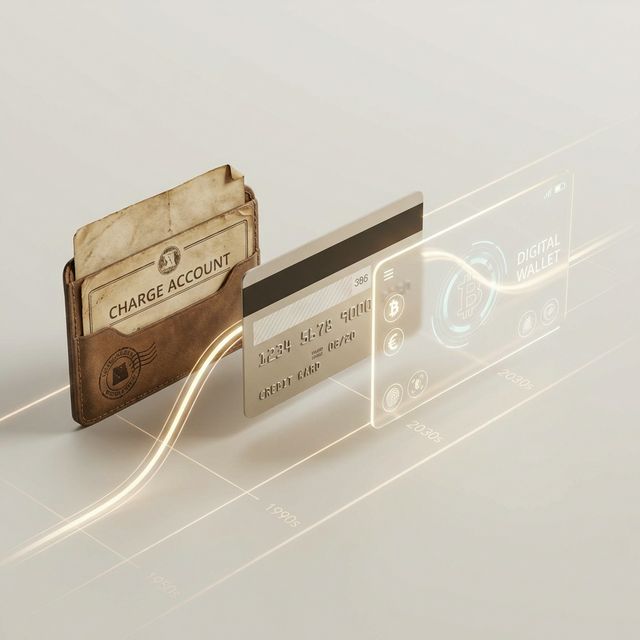
Credit cards are not just payment tools; they are a microcosm of modern commercial civilization. From solving trust issues to powering global trade, their history is full of innovation. However, while enjoying the convenience, we must return to rationality—mastering the tool rather than being trapped by it.
Origins: Solving the Dilemma of Trust and Convenience
The birth of the credit card stems from an awkward dinner story.
In 1949, American businessman Frank McNamara was entertaining guests at a New York restaurant when he embarrassingly realized he had forgotten his wallet. This experience sparked an idea: could there be a credential that allows merchants to trust a customer's ability to pay, enabling them to "charge it now and pay later"?
The following year, the Diners Club was founded, issuing the world's first modern charge card. Although it was just a cardboard card at the time and limited to select restaurants, it pioneered a solution to the core problem of commercial transactions—Credit. It freed buyers and sellers from the constraints of immediate cash settlement, greatly facilitating consumption.
Accelerator of Global Commerce
Over the following decades, credit cards evolved from a status symbol for a select few into a globally continued payment network.
In the development of world commerce, credit cards acted as both a "lubricant" and an "accelerator." They broke down geographic and currency barriers, making cross-border spending as simple as buying water at a local convenience store. For merchants, credit cards reduced the risks and costs of managing cash while expanding their potential customer base. For consumers, they provided an unprecedented extension of purchasing power.
Major Global Card Organizations
Behind this vast network, several names are essential, forming the cornerstone of global payments:
- Visa: Originated from Bank of America, now one of the world's largest payment networks, known for its extensive acceptance.
- Mastercard: Visa's main competitor, also possessing a massive global network.
- American Express (Amex): One of the oldest, famous early on for traveler's cheques. A symbol of premium service with its own independent closed-loop network.
- UnionPay: From China, growing rapidly in recent years. It is currently the largest card organization by issuance volume, with increasing global influence.
- JCB: Originated in Japan, with high acceptance in Asia and popular tourist destinations for Japanese travelers.
The Double-Edged Sword: Impact and Reflection
The impact of credit cards on people's lives is profound, like two sides of a coin.
The Positive Side: Freedom and Security
They provide emergency funds, solving urgent needs during medical emergencies or travel mishaps. They build credit history, a passport for personal economic reputation in modern society. Their rewards and benefits systems allow savvy consumers to "save while spending."
The Negative Side: The Debt Trap
However, convenience brings temptation. The painless nature of overdraft spending can easily lead to impulse buying. Once out of control, high revolving interest and late fees become heavy shackles, trapping people in debt.
Our Philosophy: Rationality and Living Within Means
This is TodayKa's core philosophy. We believe credit cards should be tools serving
you, not masters controlling your life.
Rationality means thinking clearly about needs and capabilities before spending.
Living within means implies that all advanced consumption should be based on
certain future income.
We encourage everyone to fully utilize the world's tools—enjoying the cash flow value of
interest-free periods and the feedback of rewards—but the premise remains forever: Stay
clear-headed and in control.
Be a Smart User of the World
Download TodayKa, manage interest-free periods scientifically, and walk with reason and wealth.
Download on App Store